Dr. John Loudon – Troy’s 2nd Physician

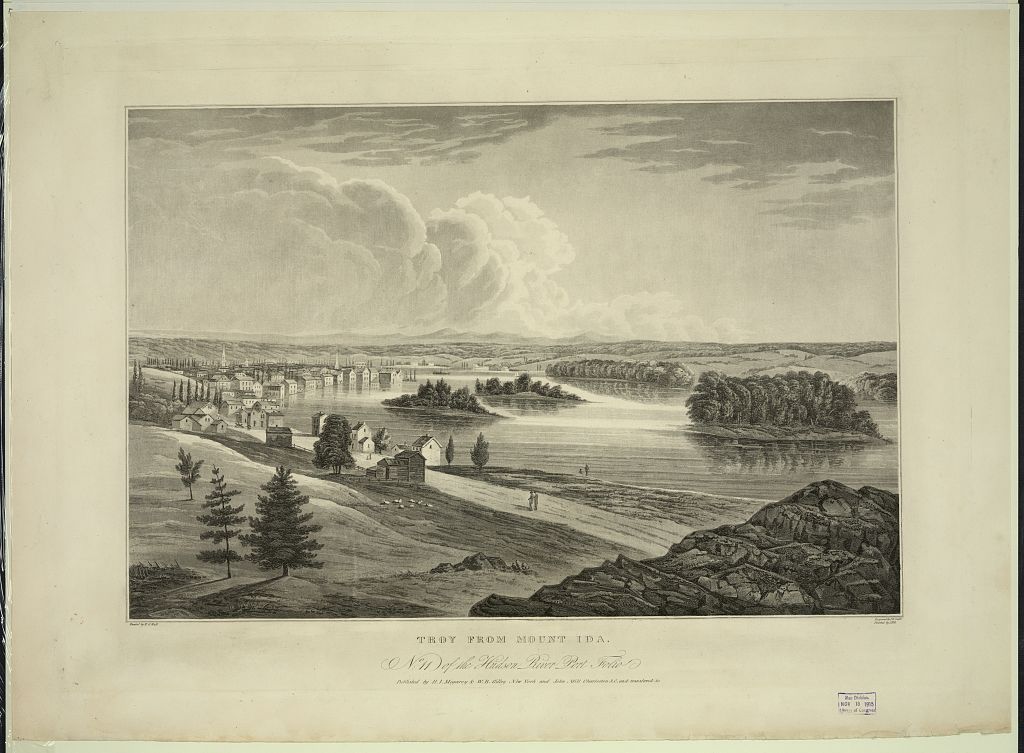
Troy from Mount Ida (*)/ painted by W.G. Wall ; engraved by I.R. Smith ; finished by J. Hill. Available for download at loc.gov (the Library of Congress) -*appears to be from Mt. Olympus not Ida, and is a view of Troy etched the year of Loudon’s death, 1820.

Dr. John  Loudon, (1760-1820), the second physician to arrive in Troy, became an important early member of the landowning dignitaries in Troy, known for his generosity and kindness to those with little with which to pay for care. As we shall see, he also took a robust interest in matters of religion.

I have written before of Loudon’s “dream of pigeons,” which seems to have persuaded his very reluctant brother-in-law, Jacob D. Vanderheyden, to let the Methodists buy the land our buildings now sit on. This same landowner had previously either donated land for other denominations, or sold them for one dollar.The fact that only the Methodists had to pay top rate (plus interest in the form of rental until paid off) is  one of the many signs of the distrust with which the denomination was treated in the late 18th and early 19th century. Loudon’s dream, when he had not yet officially joined the Methodist Episcopal Church, became such a legend that fifty years after his death,various newspapers nationwide were still reporting the dream story. The Cincinnati Daily , on December 8th, 1873, reported:  “The Troy Press says that the site of the State Street ME Church was selected ‘because of a dream’ upward of 50 years ago as reported by Dr. John Louden, a prominent physician(…) who was a leading member and worker of the Methodist denomination(…) the good doctor dreamed he saw a flock of white doves alight on the corner of State and Fifth Streets. The impression was so vivid that the doctor could not shake it off…”.

The seriousness with which Loudon took his decision to join the Methodist movement, despite it being deemed at best unseemly, and dangerous at worst, has left us with documentation on how much emphasis people of the time put on their spiritual wellbeing. At a time when people choose a church, if they choose one at all, on the speed the priest can get through the mass, the ability of the band, or its political bent, the idea of such theological heart-searching seems quite alien.

Loudon was born in 1760 in  Dungur, county Antrim, Ireland, of Scottish parents. Sylvester writes: “John Loudon, M. D., on his settlement in Troy as a physician and surgeon made himself known to the public by advertising in the American Spy, published in Lansingburgh, the following card: “The subscriber, having finished the studies of physic, surgery, and man midwifery at the University of Edinburgh, and practiced in Europe for some years past, now offers his services to the inhabitants of Troy. John Loudon, Troy, Feb. 14, 1793.”  (p.136) He soon began to work alongside Dr. Gale, Troy’s first physician. In 1794,  working together, the two doctors treated a  smallpox outbreak,and were reportedly “extremely successful.” They estimated Troy’s population as being 400 and 500 at that point.

A.J.Weise, in the History of the City of Troy from the Expulsion of the Mohegan Indians to the present Centennial year of independence of the United States of America , 1886  (pp 82-3) recounts a story in the Troy Gazette of July 8, 1806, which reminds us how different life in the new settlement was: “It was not an uncommon sight to see bands of wandering Indians in the streets of the village at this day. The Stockbridge tribe was more generally represented than any other of the aboriginal people of Northern New York, for they were claimants of the territory of Reensselaerwyck on the eastern side of the Hudson River, and in this respect were more in favor with the people than the Mohawks of the western side(…) On Friday, 4 July in this village two Indians we believe in the Stockbridge tribe, fell into dispute(…) Participating largely in the liberty and liquor, which usually warms the breasts of independent and unshackled patriots of all professions on the Fourth of July, and not submitting themselves to any laws, they fell into fighting.”  The elder stabbed the younger one,  who then attacked the elder one with a heavy stone, breaking his skull and beating him with his bow. Bystanders thought him dead, but after  a few minutes, he got up and walked away. Having been committed to jail, Dr. John Louden was sent for and he “trepanned the skull of the older Indian, and removed the broken parts.” The ultimate fate of the man is unreported.

The same author in his book, “Troy’s 100 Hundred Years” wrote: “I could name a number of individuals who would be an acquisition to any place, such as (…) Dr John Loudon” one of the 10 names he mentions ( p 46). Loudon had quickly become a respected member of the community. At various times he was a fire warden, village trustee, assistant alderman when Troy was first made a city, a (Methodist) church trustee, previously an elder in the Presbyterian Church, and surgeon for the 1st Regiment, 2nd brigade, under Gilbert Eddy. He was married twice but there is no evidence of him having any surviving children

Like the majority of early arrivals in Troy, Loudon was Presbyterian, and had been a keen student of religion since his teenage years. Like many others he had grown up within strict Scottish Presbyterian traditions: John Knox studied with John Calvin in Geneva in the 16th century, and created the Church of Scotland – the Scottish Presbyterian church – when he returned home. The first dedicated religious building was a small white wooden building in what is now Sage Park, at the corner of Congress Street and 2nd Street.  As Troy grew, numerous other Presbyterian churches sprung up, many a couple of hundred yards from another. Gradually other denominations built buildings – the Baptists, Episcopalians and Quakers all built early places of worship. In 1808, the Methodists who had been meeting in private homes in and around State Street for 15 years, decided they wanted to build on a lot beside the common land at Fifth Street (now Avenue.) When they asked to buy the lot, the owner, Jacob D. Vanderheyden refused but John Loudon secured the purchase through his compelling dream – and family influence (his second wife, Blandina Owen, was the sister of Vanderheyden’s second wife, Mary).

Was Dr. Loudon already intrigued by Methodist challenges to Calvin? He would of course have known some of Troy’s leading businessmen who were Methodists, even working in official village business alongside them: Stephen Andres, Le Grand Cannon, Mahlon Taylor, Oliver Boutwell and Samuel Goodrich, the principal of the small school which stood in what is now Sage Park. Did he meet some of the very early but dedicated Irish Methodists before he emigrated? Or was he simply aware that his brother-in-law was singling out this one group in a prejudicial way and it offended his sense of fair play? We cannot know, unless something written by him comes to light. Either way, he came to the aid of the small Methodist society and they were successful in getting the land, even if they paid exorbitantly for it.

Less than two years later, Loudon relinquished his membership in the Presbyterian Church and became a Methodist. The letters he wrote to his Presbyterian pastor, Troy’s first clergyman, Dr. Coe, and his Presbyterian congregation, became the basis for a long obituary written by William Ross. It was  published in two parts in the Methodist Review magazine in May and August of 1820, within weeks of his death. The article shows the serious way Loudon made his decision and his careful study of the pertinent differences between the thinking of Calvin and Wesley. Loudon may have been unusual in explaining his thought process as he surrendered his title of elder in the Presbyterian Church, but from the few hints we get from the journals and the books held dear by early Methodists, clergy and lay, his understanding of the theory of religion was not unique: people wanted to be sure their soul was right with almighty God, and they wanted to know it for themself.

So here are some of Loudon’s own words on why he was renouncing a Calvinist world view, for an Arminian understanding (Jan Arminius was  a Dutch Reformed Church theologian and influencer of John Wesley.) If you want to know a little bit more about what Loudon is discussing here, or to understand his points, I have posted immediately before this article, on this website, a comparison of Calvinist and Armenian thought in modern language,  and includes links to more information.)

In 1810, after sending this letter, Dr. Loudon joined the State Street Methodists. Ross quotes him: “I beg your attention for a few moments, while I address you as the congregation of this church. By your appointment, I’ve had the honor of holding the office of Elder among you, I now resign that office to you, because I cannot in conscience hold the doctrines, which are taught in this church, and which are supported by the Session in general. In the first place, they say God directs by his sovereign agency all things. To this, I reply: though God is the author of every good and perfect gift, yet he neither determines nor directs the sins of any of his creatures.… In the second place, they held that God in the dispensation of his grace through Jesus Christ gives two kinds of grace, the one sovereign and special, and the other common. To this, I answer the grace of God, which brings salvation has appeared unto all  men and there are not two kinds of grace, one real, and the other counterfeit, but there is but one kind. It may differ in degree but not in equality (…)They say in the third place, that having received a special grace, they never can fall from it, nor make shipwreck of their faith. In answer to this, I would refer you to all the cautions and admonitions given to the church.(…) To differ in some speculative points and religion has been common in all periods of the church; but for members of the same church to differ in the first and most essential principles of religion, has not been so common.“

Loudon then expanded on these points, adding quotations from the Bible, for each objection. 

In the following month’s magazine, the obituary continued with comments on Loudon’s character. Ross writes: “He first became acquainted with the Methodist in this city (…) When he joined us, our church in this place was inconsiderable and obscure(…) Both as a private citizen, and as a practicing physician, he was highly respected. As a citizen in common life, he endeavored to promote peace, propriety, and good order, in every department of society. This he did, not only by precepts, but also by examples of sobriety, industry, and economy. He was a lover of peace; – honesty, plainness, and candour were conspicuous traits in his character. As a physician, he was deservingly honored, not only on account of his knowledge of the healing art, but in consequence of a judicious and successful application of that knowledge. And without derogating from others of the same profession, it may be said he was the poor man’s doctor. Let the poor of Troy testify how often he has entered the habitations, lighted up the lamp of hope, and the blessing of God, restored health to the sick without money and without price. But this is not the best, Dr. Loudon was a Christian. And in him, the Christian graces shone with particular luster(…) Such was the confidence we had in his integrity, that he was considered as a pillar in the church, and as a father in the congregation of the Saints(…) He was, however, particularly united in Christian affection to those with whom he was connected in church fellowship(…) In life and in death he evinced a laudable desire for the temporal, as well as spiritual, prosperity of the church.— For a series of years, he gave liberally of his earthly substance for the support of religious worship, and for the comfort of the servants of Christ, who were engaged in spreading the influence of evangelical truth. And as a monument of his benevolence in death, we are now in possession of a good dwelling-house, together with necessary appurtenances, designed to be a permanent residence for the minister stationed in Troy.

Ross concludes: “Although God had given him a robust constitution, yet his exposures in the performance of his professional duties were so frequent and great, that a number of times he was brought to the borders of the grave.“  In fact, Loudon had contracted tuberculosis in the exercise of his duty, and a few months before his death, a heavy cold had made his condition worse. For his last four weeks he was bed-bound, where, we are told, he was visited by “people of all classes” with whom he spoke about spirituality. He died in his 60th year, on Saturday,  February 12th 1820, at his residence on the northeast corner of Second and Ferry Streets, where his widow lived for twenty years after his death. The Central Library is now at that location.

Dr. Loudon had a considerable list of property from his large practice in and around Troy. The handwritten inventory, which is in the collection of the Hart-Cluett Museum,  lists all his possessions at the time of his death. It includes many pages of furnishings, household goods, clothing (6 nightcaps!), and a list of debtors, which show that he loaned money to people as diverse as church members and city entrepreneurs with business ideas, to widows needing help with daily expenses. He also owned several  properties at that time: the house he reportedly donated to the church was at 141 3rd Street, and had previously been his surgery.

A few years before his death, Loudon had been named to a committee to organize the laying out of a new cemetery. That plot was plowed over by the city around 1990. It seems possible Loudon and his wife, along with many early Methodists were buried there, as were  other Vanderheydens, as many of those early names do not occur in surviving cemeteries, or appear as names of those reinterred when cemetery land was re-purposed. The cemetery is now a patch of empty ground at the end of Cypress Street, just off Congress Street, and is flanked by the Poestenkills Gorge and Falls, and Prospect Park.

Janet Douglass, Troy, May 2026.

The disused cemetery was the subject of a YouTube video by Dr Rubinstein, who has researched many such areas in the city.  Search his videos on You Tube under Dr RGST: The Cultural Historian.

The books and magazine quoted are all available online and can be read without charge:

Methodist magazine ran 1818-1828 and is available on Google Books, as are 

Troy’s 100 years by A.J. Weise, 1891, and The History of the City of Troy, from the expulsion of the Mohegan Indians to the present centennial year of the independence of the United States of America, also  by A.J. Weise, 1876.

A History of Rensselaer County by Nathaniel Bartlett Sylvester,1880 

Troy and Rensselaer County, New York; a History: by Rutherford Hayner, 1925 are available at archive.org, the Internet Archive of the Library of Congress

The Hart-Cluett Museum is located on 2nd Street in downtown Troy and researchers can be book time in the Research Library, by going to their website: hartcluett.org 

.

“All Means All” – Wesleyan Methodism v. Calvinist Protestantism

A summary of Methodist ideas to accompany and clarify the next two essays

This is a brief review of the shock-waves caused by the introduction of Wesleyan ideas into the Protestant world of the 18th century, and why Methodist teaching felt both scandalous and dangerous to many well-meaning and seriously faithful Christians. This essay is for those who want to better understand the issues of the two essays that follow it. Today most Methodists and Presbyterians never give any of this much thought, though in the evangelical, most Calvinist wing of the church, these same issues do come up quite frequently and Wesley, his mentor, Arminius, as well as Methodists can be deemed in error.

So very briefly: the Protestant Reformation is deemed to have started when a Roman Catholic priest, Martin Luther, challenged the might of Rome in 95 “theses.” The main thrust was that people are saved by their faith alone, and that studying the Bible is what teaches us how to be people of faith. After Luther, “protestant” theologians sprang up in several countries, but John Calvin and Huldrych Zwingli in Switzerland, and John Knox in Scotland became the main proponents. Many of the first leaders of Troy were New Englanders whose families had been influenced by the Scottish Presbyterian church, founded by Knox.

The Roman Catholic and Protestant churches all have St. Augustine as the basis of their understanding. Writing in the late 4th and early 5th centuries, it was Augustine who broke one of the last ties with the Jewish faith of Jesus, with his emphasis on “original sin” which replaced the idea Jesus would have known: “original blessing.” Once original sin – the idea that humanity is “sinful”, right from birth – was accepted wisdom, the question became: if we are all all broken, how do we become whole – how does someone get right with God? It took a few hundred years, but eventually a large body of Christians decided it could not be decided by priests or bishops, or even a pope; nor could it be by being able to buy favor through deeds or donations (the medieval “indulgences”, Luther decried) –  it had to be a personal decision; it had to be about having the right faith as revealed in the Bible: this was the essence of the protestant reformation.

Calvin, Zwingli and Knox were the main explainers of this new take on faith, but they had challengers and chief among them was a minister of the Dutch Reformed church, Jacobus Armenius, and it was his arguments, not Calvin’s, which convinced John Wesley, founder of Methodism. The two understandings of the nature of God and how one “gets right” with God are incompatible, often in complete opposition. There are many resources to help someone understand these two opposing views and links follow my essay, but here is a short summary of Wesley’s objections to the already well established Calvinism of his day.

“The Five Points of Calvinism” are occasionally known by the acrostic TULIP: Total Depravity, Unconditional Election, Limited Atonement, Irresistible Grace, and Perseverance of the Saints.  Wesley’s followers created their own four point summary of their faith from his writings: the Four Alls.

In Calvinism, Total Depravity means that everyone is born to sin, that loving God is unnatural for humans, and are therefore morally incapable of being “saved”, redeemed, or becoming holy, unless God affects it for them. Unconditional Election is the option that God chose, at the beginning of time, who would be elevated to being in relationship with God, regardless of their deeds and even, as we will see, will: the rest get to suffer the wrath they deserve for being born sinful (I realize you may be thinking what I do here…but I am just telling you what Calvinist belief is… I am obviously not Calvinist.) Limited Atonement decrees that only the elect, as above, get to enjoy the benefits of Christ’s atonement, that is, are forgiven for being born sinful. Irresistible Grace claims that because some people were chosen by almighty God, those people are acceptable to God whether they like the idea or not, because God cannot be resisted, and Perseverance of the Saints  just means that because God chose them and they are saved and put right with God, they cannot lose that status. (If they later do something really heinous, then that shows they were never really one of the elect.)

In contrast, John Wesley, basing his writings on Arminius, denounced Total Depravity and declared people were not depraved but alienated – without a knowledge of God; instead of Unconditional Election, Wesley believed people can choose to be one with God, to choose to be God-fearing (God-loving). Instead of Limited Atonement, he proclaimed that God’s love is freely available to all  –  if they want it; as for Irresistible Grace:  for Wesley, grace is not irresistible – someone can choose to resist God’s grace, so they have a choice to make. Lastly, instead of Perseverance of the Saints, Wesley wrote that people can have a sense of security and assurance in their faith, but that a life with God should bear the marks of that life in the way it is lived. It includes a call for holy living, so that the person does not fall back out of the state of grace.

So Wesleyan theology is sometimes summed up as being about the “Four Alls”:

All need to be saved (put in right relationship with God)

All can be saved (all does mean all)

All can know they are saved (feel reassured of being accepted by God)

All can be saved to the uttermost (we can continue to grow in holiness)

When the first Methodists arrived in the village, later city, of Troy, it was almost exclusively Protestant, and overwhelmingly Presbyterian. Of the other early faith groups – the Baptists were also strongly Calvinist; only the smaller group of Quakers, and the Episcopalians were not. A few decades later, Lutherans, Roman Catholics, Universalists and Unitarians and other faith groups arrived, less linked with Calvin, but the first pioneers of Troy, and especially the leaders would have considered, like most migrated New Englanders and recent European immigrants of the day, that Methodist teaching was radical, absurd, not sensible and probably dangerous.

What matters is: people took their faith and the concern of their eternal condition extremely seriously. What would happen to your eternal soul if you chose the wrong option? And in this choice the Methodist way was both more recent and a minority opinion: novel in every sense. But there was also something in this message that gave ordinary people hope and excitement, as we can tell by the fervor with which they embraced the teaching of preachers and those who spoke at the frequent revivals and camp meetings.

It is against that background that we see the likes of Dr. John Loudon so deliberately and ponderously, even shockingly,  take a deliberate step away from the majority denomination of the early leadership of Troy, of which he was a member, renounce his Presbyterian membership, and join the Methodists. His treatise, printed over two magazine articles after his death, is testimony to the amount of theological research and thought and prayer he put into that decision. Two hundred years on, it is almost impossible for us to imagine or believe that all this took up so much of people’s time and waking thoughts. The fact that it did explains the difficulty of bringing a new faith idea into the public conscience, which was what our early State Street Methodists were aiming to do, despite public opposition. The following essay features Dr. Loudon, and the one after that describes the physical violence early Methodist preachers endured for their convictions and the mockery and prejudice faced by the Methodist societies.

Janet Douglass, Troy, NY

May 2026.

There is an excellent and succinct 11- minute video on YouTube, which can be found by searching for “The Four Alls: Summarizing Wesleyan Theology” by Rev. Daniel Hixon. It includes the New Testament verses Wesley created these all from, if you need further information on why he affirms these things.

From the internet site, The Voice: Biblical theological resources for grown Christians: “Tulip Calvinism compared to Wesleyan Perspectives” by Dennis Bratcher ” at  https://www.crivoice.org/tulip.html or search for TULIP Calvinism and Wesleyan by Dennis Bratcher for a handy chart with the differences side-by-side.

There are also many contemporary arguments in favor of a Calvinist approach available on the web, as both text discussions and on YouTube.

A remarkable Troy woman and the burning of the Henry Clay

A story about the remarkable early Methodists of Troy, NY and especially those associated with the State Street Methodist Episcopal Church and its branches.

Nathaniel Currier (American, Roxbury, Massachusetts 1813–1888 New York)
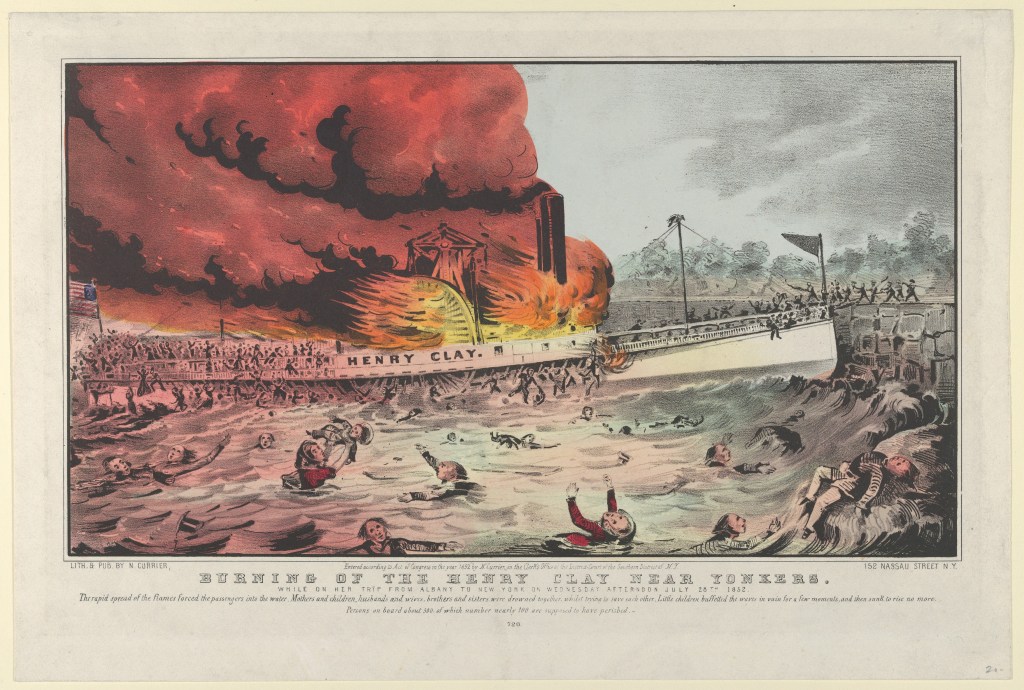
Burning of the Henry Clay Near Yonkers–While on Her Trip From Albany to New York on Wednesday Afternoon July 28th, 1852.–The rapid spread of the flames forced the passengers into the water. Mothers and children, husbands and wives, brothers and sisters were drowned together, whilst trying to save each other. Little children buffetted the waves in vain for a few moments, and then sunk to rise no more. Persons on board about 500 of which number nearly 100 are supposed to have perished., 1852
American,
Hand-colored lithograph; Image: 7 9/16 × 13 1/2 in. (19.2 × 34.3 cm) Sheet: 10 1/16 × 14 15/16 in. (25.5 × 38 cm)
The Metropolitan Museum of Art, New York, Bequest of Adele S. Colgate, 1962 (63.550.101)
http://www.metmuseum.org/Collections/search-the-collections/662253 (Public domain.)

“One of the most touching incidents illustrative of the sanctifying power of God’s grace and the Christian fortitude of a pious woman, I may here relate as a tribute to the memory of a much- loved relative and an estimable member of the State Street and Congress Street societies, Miss Elizabeth Hillman, familiarly called Aunt Betsey Hillman, who was well-known to all its people as an earnest Christian and a zealous worker in the Lord’s vineyard. During revivals she frequently gave evidence of her joyous exaltation of soul with loud shouts of praise and hallelujahs. On

Tuesday evening, July 27, 1852, while present at a prayer-meeting held at the residence of Noah Clapp, a member of the State Street Church, she led in prayer. One of the special favors which she solicited of the Great Ruler and Disposer of events was that when her work was done on earth she might be called quickly to heaven, for she dreaded the pains of a prolonged illness.

On the following morning she took passage on the boat Henry Gay (sic), plying between Albany and New York. On the way the boat began racing with another steamboat, the Armenia, on the opposition line. The excited passengers became greatly alarmed for their safety. A young woman from Albany was much frightened and Miss Hillman, in her endeavors to calm her apprehensions, spoke to her about the salvation of her soul. Discovering that she had not yet accepted Christ as her Saviour, and was wholly unprepared to die, Aunt Betsy urged her to give her heart to God. This she promised to do, if she should be permitted to get off the boat alive. Shortly afterward the boat was discovered to be on fire, and was steered toward the shore. In attempting to save their lives about fifty of the passengers were burned or drowned. The young woman and Miss Hillman, in seeking a way of escape, were compelled to decide which one of the two should perish on board the burning boat. Aunt Betsy at once urged her dismayed and sorely-distressed companion to leave her, saying: “I am prepared to die, and you are not.” The young woman fortunately escaped and afterward obtained that peace of soul, of which she

delighted to speak when tearfully telling of the noble unselfishness of the Christian woman who went to Heaven in a bright mantle of flame. Her age was fifty -seven(sic.)” (Methodism in Troy, Joseph Hillman, 1888, pp79-80. She was actually 67. )

Joseph, the author of the seminal work on the history of our congregation, was the nephew of the woman in the story. He writes that the The Hillman* family, Isaac and his second wife, Nancy Hillman joined the church in 1827, as the second church structure, the “brick church,” was being built. Isaac had come under the influence of the renowned Methodist preacher, Lorenzo Dow, when the family still lived in Vermont, and became a fully confessing member of the Methodist Church in 1809, at the age of 12. In reality, as a family of German Palentines finding refuge in Ireland, his whole community was already allied with the Methodists before many migrated to America, many settling in the area of the New York-Vermont border. While Isaac and his wife immediately appear in the official membership records of the church, the first time Elizabeth HIllman is mentioned, in the surviving records, is in 1835, though she may have joined earlier. City Directories show that this extended family lived in adjoining lots on Congress Street, with Elizabeth and their brother David first appearing in the Troy City Directory in the 1837-8 edition, which says that she is “boarding” at 190 Congress Street Extended, with the rest of the family, including David. Another brother, John Hillman, a physician, appears in the Troy listing for only one edition.  

In Ireland, the family had kept their German name of Bergmann, but used various versions of the last name until the contingent who moved to Troy translated it, quite literally, into English as Hill-man. Elizabeth was born on July 1st, 1784, the fourth of 8 children born to John (see below for versions of his last name) and Mary –  also recorded as Maritia and Calreana – Miller. A book tracing the family line of her brother Isaac down to current survivors (“A Few More Left: The Story of Isaac Hillman” by Henry Z. Jones ,Jr.)  reveals that there was something of a scandalous break up between her parents, with her mother being disowned by her husband at least twice, and even by her own father who, at his death, divided her one-sixth share of his wealth between John and Mary’s 8 children, leaving none to his errant daughter. 

Her childhood went through other troubled times. In 1785, the parents and their four oldest children – including Elizabeth –  were asked to “depart the town immediately” (Bennington, VT Official records) and again in 1808 when the family were “warned out” of Shaftsbury – something that happened when a family was in danger of becoming a financial burden on a community. At the age of  24, you would expect Elizabeth to no longer be living with them, most typically already married, but a notification in the Vermont Gazette, in 1791, could explain why she might be needed with her father: her mother had left the family home. She later returned for a while, during which time their youngest child, Isaac, was born, but left again in 1799. It is tempting to play amateur psychologist on the subject of why Elizabeth never married!  Did Mary Miller reconcile with her children after their father had died? Enough, at least they buried her in the Mount Ida Cemetery inTroy, but I could find no evidence that she was living with any of them before that. 

As for Elizabeth, “Aunt Betsey”, what we do know is that she was baptized as Elisabetha Barrackman, later Hillman,  and is recorded in the Gilead Lutheran Church books of Center Brunswick, NY. which is intriguing, but there is family history linking the family to that area, including her mother’s family being in Brunswick. At the time of her birth, the family was living in Shaftsbury, VT and attending the Fourth Church, which later became the Shaftsbury Baptist congregation. Baptism In Center Brunswick would suggest this did not happen when she was a baby. Other siblings spent time with Isaac at various points of his life, in Middleburgh and then Lansingburgh, which is when Elizabeth reappears in records in1824. This was where Jerusha Sweet Hillman, Isaac’s first wife died, shortly after their second child was born – did she move in to help care for the children until he remarried? Either way Elizabeth was then to remain close to Isaac for the rest of her life.

During her life, Elizabeth conducted various property transactions, and at her death still owned a house in Lansingburgh, as well as being the owner of land on Congress Street, though she had previously sold some of the lots. There is no mention of any work she was undertaking in the city directories, but may have helped Isaac in his on-site business endeavors. She seems to have been left with sufficient money by earlier family members – her maternal grandfather is the one we know about –  in order to buy land. It was enough for her to be generous, too: Elizabeth is listed as one of three major benefactors of the Congress St, later Trinity, Methodist Episcopal Church on 13th Street. The cost of building the church was $6,199.84 , but half the cost was donated by just three people: Elizabeth, Isaac and Alvin Williams. It faced the entrance to Prospect Park, and burned after the congregation had merged with the State Street church in 1965. (I have an essay about the church on this site.) 

It is easy to presume she was a dour, unmarried, and hyper-religious presence, but her appellation of “Aunt Betsey” by church members and the fondness felt by her nieces and nephews belie that idea. Joseph Hillman calls her a “much loved relative.” She was certainly fiscally astute, especially in comparison to Isaac, who was far more prone to taking risks, making and losing and remaking his fortune on several occasions, though he was not to blame for them all! 

Elizabeth’s life is a reminder of the danger** of the only feasible way for people in Troy and environs to travel to New York City, which they did, in surprisingly large numbers: by boat. It was a cut-throat business. Numerous companies rushed from port to port trying to get ahead of a rival boat to get all the passengers.  Elizabeth’s final voyage, indeed, was not the only time she was involved with a ferry boat disaster on the Hudson.

A report in The Daily Whig newspaper in April, 1845, has Elizabeth Hillman of Troy, who was rescued from the The Swallow when a sudden snow squall caused the boat to strike a  rock near Athens, NY, and within 5 minutes the boat was at the bottom of the river. A long list of passengers were rescued, but a few drowned, including Elizabeth Spencer, a “young convert” according to Joseph Hillman, who had only 8 days earlier united with the State Street congregation. (Methodism inTroy, p.63) Was she traveling with Elizabeth? We do not know, but  how could that event not have influenced Elizabeth’s decision the next time she faces tragedy on the Hudson?

The New Yorker magazine in 1938 published a dramatic description of the fatal trip which claimed Elizabeth’s life (see link below.) The burning of the Henry Clay was the catalyst for a state law finally banning the racing of commercial ferry boats down the Hudson. It was too late for 50-80 souls (reports vary) including Elizabeth, though her brother Jacob, who was also traveling, did survive, and brought her body back to Troy.

Her death was officially given as drowning, although the telling of the story by her nephew makes it sound like she burned. A photo of her body in Jones’ book, taken after her recovery from the water, shows some dark marks, like soot, but is basically intact: she must have jumped or fallen from the boat, as others did, and drowned.

After her funeral, held at the Congress St Methodist Episcopal Church, Elizabeth was buried in the Mount Ida Cemetery, where her mother, brother David, and sister-in- law, Nancy, had all been buried before her. The memorial on her gravestone is quoted in the 1923 book, “Inscriptions of Graves from Mt. Ida Cemetery, Pawling Ave, Troy N.Y.” recorded by the Daughters of the American Revolution: “Elizabeth Hillman, one of the sufferers by the burning of the Steamboat Henry Clay, on the passage from Albany, N.Y. July 28, 1852. Aged 67 years.” 

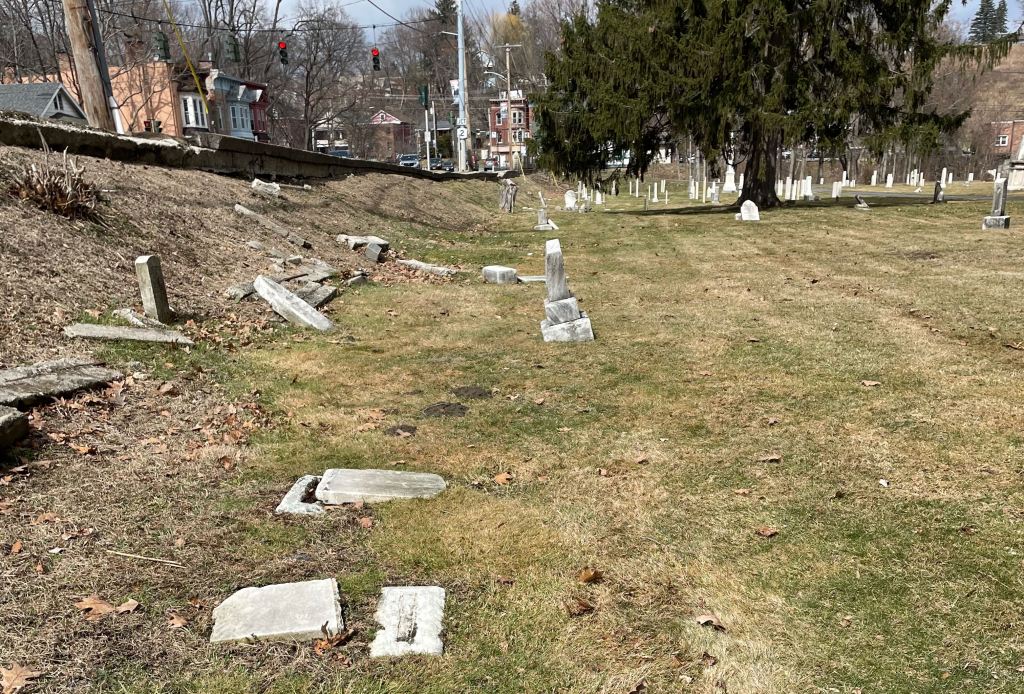
With no photos on the Find-a-Grave site of these four Hillman graves, I presumed the sites had been lost, and an hour’s walk around the site on a recent cold, wintery day, proved what a small percentage of the hundreds of graves are visible. Many stones have fallen, even in the past one hundred years since the DAR, with difficulty, recorded the inscriptions. Stones are broken, fallen on their face, have been completely covered by grass, have fallen down the hill and onto the walk beside the Poestenkill or become victim to subsidence at the edge of the road. Those that stand are frequently so worn by wind and rain as to be illegible. Volunteers continue to work on the site to restore and preserve the stones of hundreds of early residents of Troy, including many from the State Street congregation. So, it remains with us to remember this courageous and faithful woman, who, with her family, became such an important part of the State Street, and Congress Street, congregations. In the third quarter of the 19th century, Troy was an overwhelmingly Methodist city – hard to imagine, I know! – and Elizabeth and her family surely played a large part in that, through their financial support, but also through their dedicated demonstration of a faithful Methodist way of living. 

Janet Douglass, Troy, NY, March 2026.

*Her father’s last name and some of the older children’s, was variously recorded as  Birkman, Barckman(n), Barkman(n), Barkemann, Barrackmann, Barrickman, and Banackman but Isaac and the family, including Elizabeth, her brothers David and Jacob, and mother Mary, seem to have chosen the literal translation from the German – Hillman – at the time they move to Lansingburgh and Troy. 

**In a sad postscript, this was not the last family tragedy caused by a racing steamboat. Her nephew, Isaac’s son born to his third wife after they moved to California, died when a racing ferry boat caused numerous passengers to be drowned, and nearly cost the boy’s mother life, too. Indeed Isaac himself had earlier been at risk of dying in a weather-related disaster at sea.. Isaac Hillman is such an interesting character he easily deserves an essay of his own: stay tuned!

An online copy of the DAR record of inscriptions at Mt. Ida Cemetery, Troy, NY.

Dramatic description of the race and the ship’s burning, when 50-80 of the 500 passengers died, the boat finally crashing near Yonkers. 

https://www.newyorker.com/magazine/1938/07/23/the-fatal-hudson-river-steamboat-race

Also see the Wikipedia page for the boat and the disaster (Henry Clay 1851 steamboat)

The Swallow ferry boat disaster is described here:

The quoted biography of Isaac Hillman and his descendants is:

“A Few More Left: The Story of Isaac Hillman” by Henry Z. Jones ,Jr pub. Penobscot Press, 2005.

The County land records office in Troy, is the source for land transactions deeds for the family.  The Central Library’s Troy Room holds all City Directories, since they began in 1829. 

The 19th Century Struggle for Musical Instruments in Worship

The use of musical instruments in the church, it should be known, was not approved by its early members and no little opposition was shown to the gradual innovations that were made to support the congregational and choir singing with such instruments as the bass viol and organ. At one time, the singers in the church attempted to introduce the use of a bass viol and obtained a player to bring one to the church for a rehearsal. Seeing the objectionable instrument in the gallery, while on his way to class-meeting, Isaac Hillman took his pocket-knife and cut the strings of the viol, thereby defeating, the purpose of the ambitious choristers. Although he had used so summary a method to sustain the authority of the society, he nevertheless indemnified the viol-player for the loss of the strings of his instrument.(Methodism in Troy by Joseph Hillman, son of Isaac, p. 60)

Accompanied music in churches today seems so very ordinary, it is hard to consider what outrage the introduction of musical instruments into worship could possibly have caused, though there are Christians denominations to this day which forbid their use. In fact, many of us are  very familiar with the very opposite of that: friends and family members for whom the absence of a fabulous organist, extensive voice or hand bell choir, or a great band, is reason to avoid a church altogether. 

Our early records reflect the progression happening in many Protestant churches of the day: from unaccompanied congregational singing and chanting  – solos were also impermissible –  to the arrival of an organ. Indeed, we even have the wording of the original letter detailing why a group of leaders tried to prevent it.

So what was the problem? After all, the Psalms, in the Christian Old Testament, mention singing and dancing accompanied by musical instruments. The issue centers on the fact that in the brief comments in the Book of Acts, and in the Letters, about the early gatherings of those who followed “the Way” of Jesus, mention no instruments by name. When the people driving the Protestant Reformation started to look closely at the Biblical texts, intending to return worship to what they felt had been its original form, they found no instruments mentioned and began to call accompanied singing a “heresy” and so they outlawed it.

The records of the State Street Methodist Church reveal the hesitancy of moving away from this received Protestant wisdom. The congregation had been hiring a succession of men to teach multi part singing in the “classes” as well as to general congregation, from at least the late 1820s. In the early 1830s, the choir requested they be allowed to rehearse, at least occasionally, and for a one month trial period, with a bass viol: a very tentative step, indeed. They understood there would be objections, as detailed above. Nonetheless, the choir prevailed,  and the bass viol appears to have become somewhat acceptable in Sunday services within a decade. The idea of installing an organ, however, would  be a far larger step, partly it seems, because siting an organ seemed such an irrevocable step, and maybe even an offensive one to the very structure of God’s house.*

Christian Heritage Edinburgh has this brief history of the organ in worship:

“In AD 670 Pope Vitalian introduced the first organ in church history at the cathedral in Rome, but organs were not widely played in churches until the eighteenth century. In fact often they were met with great suspicion and even anger. The organ gradually made its way into general usage in the Catholic Church by the thirteenth century but some of the Reformers, particularly John Calvin (1509-1564), considered it an instrument of the world and the devil.” 

Even so, by the mid 1700’s organs were being installed in congregations in New England, especially in Episcopal and Congregational churches, and pressure gradually mounted in all denominations to include musical instruments, with a large and complicated organ as a prized status symbol.

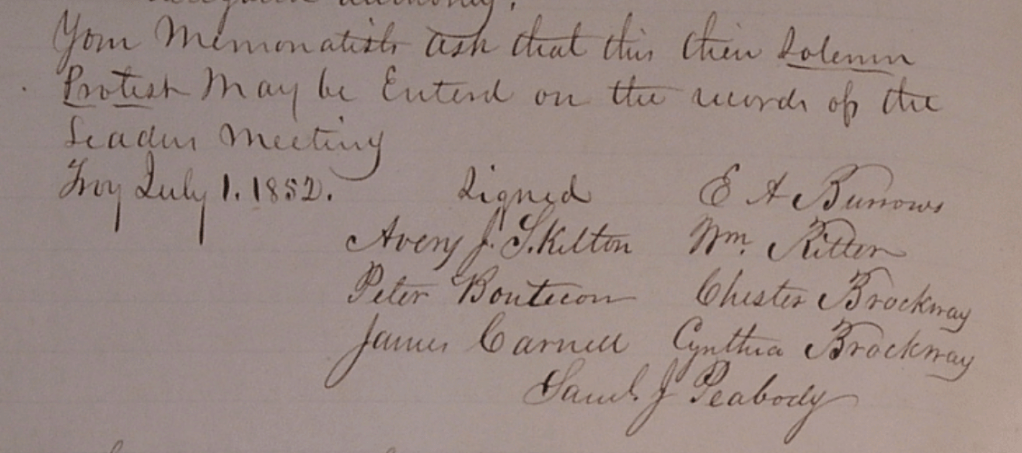
In the State Street Methodist society, those who fought hardest to prevent the acquisition of an organ called themselves the Memorialists. They were led by Dr. Avery J. Skilton, and when their cause appeared unsuccessful, they requested that the Leaders print their letter of objections, in full, in the minutes of their meeting held on August 22nd,1852. It begins: 

” To the Leaders and Stewards Meeting regularly assembled Brethren. 

A Church is an assemblage of pious persons associated together for the purpose of worshiping God, and of mutually aiding each other by advice, encouragement and exhortation to a Godly life and conversation, and to the exercise of holy disposition,” After several hundred words it concludes with a summary of the complaints of the Memorialists, who believed the leaders had made an “absurd” choice because firstly, the use of musical instruments is “unsanctioned by the Gospel”; an “imposition on their feelings” of people who joined the Church before this addition; an “injustice in a trespass upon the rights of property” of the members have paid their annual pew rental (threatening legal actions of trespass no less!); “an attempt to force the Church of God into accordance with man’s political preferences” (a comment on a presumed perceived imbalance between the objectors and those saying nothing, versus the leadership); “A withholding of the right of private judgment and conscience” – because there had not been a general ballot; and finally, they declared that the Leaders’ Meeting had “transcended its powers” and“violated the rights of members without the shadow of delegated authority” – a complaint that there had not been a vote for everyone, but neither were the leaders elected by the congregation as their representatives. The letter was signed by Dr Avery J. Skilton, Peter Bontecou, James Carnell, E. A. Burrows, William Ritter, Chester Brockway, Cynthia Brockway and S(Samuel? Sarah? Saul?) J. Peabody. 

By early 1853, the organ was installed and the topic only reappeared in the minutes when requests were made in following months to first “dispense with the organ voluntarys”(sic) and later, the organ interludes, showing that while the organ was deemed helpful in hymn singing, not everyone was comfortable with it being used in a performative way – or maybe this was a nod to those who had objected all along. The disagreement had been intense and passionate, yet those who protested the installation of the first organ did not leave the congregation when they failed. If limiting the use of the organ for a while was a small accommodation to its detractors, who had not simply moved on when they lost the discussion, this author can find it nothing other than heartening.

Janet Douglass, Troy, NY. February 2026.

*The organ discussion takes place in the Leaders’ Minute Book which records meetings from1849. It begins with the February 1852 meeting: “On motion of Bro. Matthews, it was resolved that the chorister be permitted to introduce an instrument called the melodion into the choir of the church on trial for one month.” Permission was continued for another month in March, but there was a motion “to rescind use” in April, but the decision was delayed after much discussion. A second April meeting and another long discussion ended with the resolution “in view of the feeling of the church on the subject of instrumental music in divine worship the purchase of an organ for the above purpose is inadvisible.”   At the meeting on July 2, 1852, “Dr. Skilton presented a paper…purporting to be a protest against the erection of an organ in this church, which he desired to read.” on the subject, and the following month his paper was recorded in the official minutes, as above. 

The first organist of the church was Mr. Conant who had first been hired as the Singing Master or Chorister, both terms are used, in November 1849. He was discontinued some months later, rehired in December 1850 and in February of 1852 he made the request to introduce a melodion. After Mr Conant left his position, the society tried to hire a Mr. Clucas but this led to strife with the leadership of St Paul’s who also believed they had hired him. There is no evidence he ever took the position with the Methodists, but Mr William Cluett did,  and the long and generous history of the Cluett family and this group of Methodists, began.


Quotation on the history of the organ is from www.christianheritageedinburgh.org.uk

For a contemporary take on the” heresy” of musical instruments in worship, read https://www.swrb.com/newslett/actualnls/InstrHer.htm

A curious link between Troy, NY State Street Methodists & the Birth of the Salvation Army

Stories from the lives of members of the State Street Methodist Episcopal Church

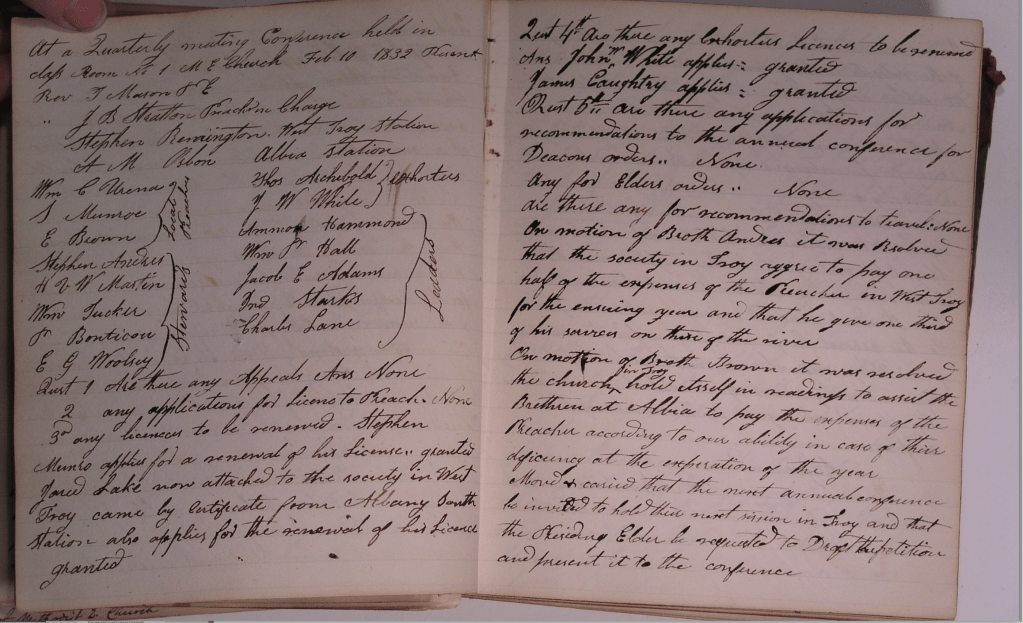
Minutes of the Quarterly Meeting of the State Street ME Church, Troy, NY February 10th, 1832, showing the approval of our subject as an exhorter (top right.)

What name links the State Street Methodists to the very beginnings of the Salvation Army? We should start with a little background: you may have heard that the Salvation Army was founded by William Booth in England, but did you know that before that Booth was a Methodist preacher? Indeed, at one point of his career Booth was preaching in the very same Gateshead Methodist pulpits as your author, as that is where I was living and preaching before moving to Troy…but I am not, of course, the link in question! The link I am writing about goes back to the mid 1800’s, and concerns a preacher, forgotten by most people, but about whom much has been written because of his preaching successes on both sides of the Atlantic. And it’s a story which begins with Troy’s State Street Methodists.

James Caughey’s name is no longer familiar to us, but in his day, his preaching and books were frequently mentioned in pulpits and newspapers, in America, Canada and in Britain, where he was popular with the masses – while being frequently unpopular with the developing hierarchy of the church. He was an old-fashioned revivalist, calling the people to repentance and a new way of life. The Southern Christian Advocate newspaper on Friday, July 23rd, 1852, called him “one of the remarkable men of our time. We suppose him to be the greatest revivalist now in Christendom.” and the Philadelphia Enquirer of April 4th, 1857, wrote: “This distinguished divine has been preaching at the Salem M.E. Church (…) with the most astonishing success.” But as the church moved away from noisy camp meetings and rallies, and moved toward a style more suited to middle class adherents, his methods began to sit uneasily with the leadership, first in England, and later in America, and his achievements were mostly forgotten.

James Caughey was born on April 9, 1810, in northern Ireland. His parents were Scottish, and he was raised, not surprisingly, in the Presbyterian Church. While he was still a boy, the family moved to Troy. There had been a steady flow of Irish protestants to New York for two decades already, attracted by the explosion of industrial jobs to be found. By the time he was 15, Caughey was employed in a local flour mill, where he apparently came into contact with some of the early Methodists of the city. At this point State Street was the only Methodist society in Troy, and was in the process of building its second and larger brick sanctuary, at the front of the lot now occupied by the garden. There is no record which mill he worked in, but there were two families in the congregation with a long history in milling, and the existence of workplace Methodist practice is known to us from the history of Levings Chapel in South Troy, which was set up soon after this time, when a group of workers at the nail factory began to meet in a Methodist class, either before or after their shift. So he may have been encouraged to visit State Street M.E. by his co-workers or management.

For someone who left us so many of his words, Caughey was quite reluctant to offer details of this time in his life, and city directories, which only began in 1829, do not mention where the family was living. However, on several occasions in England, he mentions that he was associated with the Methodists for 3 or 4 years before he received a call to preach. Several biographies explain that change as coming from a revival in 1830 when he was still just 19 years old. The early members of State Street were very fond of holding regular revival meetings led by invited fiery preachers, at which they would record dozens of people joining the congregation at each event, as well as encouraging others to be more fully part of their baptist or presbyterian churches. In various sermons he spoke of attending many meetings and seeking assurance of his place in the family of God. At a camp meeting outside the city, he saw people who had that assurance and decided he would not rest until he found it. Caughey received what he had been craving – a sense of peace and that he was forgiven and at peace with God. It came with a duty to tell others:

“The doctrine of entire sanctification I did not understand ; … I sought the blessing earnestly by day and by night. I fasted, prayed, . and wept, and often entered into an agony of soul for the blessing. Months passed away without any other benefit than an increased spirituality of mind, accompanied by great tenderness of conscience. Sitting one day in a private room alone, reading Mr. Wesley’s Plain Account of Christian Perfection, a heavenly calm, with a consciousness of entire purity, over-spread my heart, and a light like day-dawn beamed upon my placid soul. I exclaimed, in sweet amaze, ” Why,-if this be Christian perfection, which Mr. Wesley describes, — if this be the true Scriptural view, — then I have it ; I do enjoy this very thing. The blood of Jesus Christ has cleansed me !

I held the blessing for some weeks with a trembling hand, and confessed with a faltering tongue, in the assembly of the saints, what God had wrought in my soul. The more frequently I spoke of this great blessing, confessing it, and urging others to press after it, the clearer my evidence became.” from Helps to Life of Faith, p.175

From that point on we can assume Caughey began to take his faith journey more seriously, seriously enough to request the position of exhorter at State Street M.E. Church in Troy. The image above shows his application being accepted. Becoming an exhorter in your home society was the first step in the direction of becoming a local preacher, and then an ordained minister. Exhorters operated only in their own congregation, and encouraged and led people in worship and prayer, between the visits of the traveling ordained clergy. Referring to old Conference records, Caughey’s biographers then record that he was sent by the congregation with a recommendation he receive Deacon’s orders in 1834, and that two years after that he was ordained as a Methodist elder (pastor) and sent to serve at Whitehall, NY . He was then 26 years old, but already in the intervening year, he had accomplished his first evangelical preaching tour in Canada.

On July 9th, 1839, at Whitehall, when he was struggling with the idea of whether it was time to settle down and get married, he had a vivid experience of being called to return to Canada, where he would then receive the financial means to travel to Ireland and England. Instead of choosing marriage and a settled life, he asked permission of the Conference to follow where he felt the Holy Spirit was sending him. He spent March – July 1841 in Montreal, and then sailed for England. His great success in the period between 1841 and 1847 led to him becoming known as the “King of Revivalist Preachers.” The Rhemalogy site quotes Caughey saying that he saw “20,000 profess faith in Christ and 10,000 profess sanctification,” adding that these were conservative numbers, created by carefully adding the names of those who professed faith, meeting after meeting, year after year.

Daniel Wise, who edited and editorialized some of Caughey’s letters and journals in the 19th century, presented the young preacher as a self-educated yet voracious reader but that his early career gave no indication of the huge impact he would later have in England. His Wikipedia page states that later in life “Caughey had an imposing figure and face, a forceful personality, a quick wit and great eloquence.” William Booth’s biographer, Harold Begbie said of Caughey: “He was a tall, thin, smooth-shaven, cadaverous person with dark hair. One who often saw him and well remembers him tells me that he wore a voluminous black cloak folded about him in a Byronic manner; his voice was subdued, he gave no sign of an excitable disposition, his preaching warmed slowly into heat and passion which communicated themselves with magnetic instantaneousness to his audiences.”

His presence in Britain caused enough controversy that after a few years, the leadership there encouraged him to return to the States. His preaching style had brought to a head a discussion between two factions within the British Methodist Church, and many of the leadership belonged to the group which was beginning to become less sensational, dramatic and outwardly “enthusiastic” in style – the complaint the established church had always leveled at John Wesley and his followers – and wanted the church to become more acceptable to the growing middle class. This would shortly begin to affect Methodism in America too. My co-researcher, Alice Rose, and i have both begun to suspect that a rift was growing among Troy’s Methodists by the second half of the 19th century, as the State Street church adopted a system of paid pew rentals, became less interested in revival meetings, and less invested in it evangelical endeavors – and even started using musical instruments in worship! (That is a story for another day.) Those who were unhappy with the direction moved into some of the other congregations State Street had birthed and continued earlier ways at least for a while longer.

So, after 6 years In England and a little time in Ireland, Caughey left Britain in 1847, and he returned to Burlington, Vt. making preaching tours in Canada annually for a time, as well as three more trips across the Atlantic and as an invited preacher up and down the East coast of America, from his base in Burlington, VT.

And the link with the Salvation Army? William Booth attributed his becoming a Methodist, and subsequently a Methodist minister, to the preaching of James Caughey. Booth was just 15 years old when he first heard Caughey. The Wikipedia page for William Booth says: “William styled his preaching after the revivalist American James Caughey, who had made frequent visits to England and preached at Broad Street Chapel, Nottingham, where Booth was a member.”

In his 1920 Life of William Booth, Harold Begbie writes about Caughey’s influence and includes a new paper article describing what it was like to attend one of Caughey’s meetings. The full text is available online (link below) but it begins: “But the greatest influence upon William Booth was exercised, beyond all question, by the American evangelist James Caughey, a minister of the Methodist Episcopal Church. This man attracted enormous crowds to Wesley Chapel, and brought about an undoubted revival of religion in the town.

Eventually, as the tension between the old-time revivalist preachers and the leadership grew, Booth left Methodism and formed his own organization based on the principles and understanding, and even the language, he had first heard from his mentor, James Caughey: the Salvation Army was born.

As for Caughey, ill-health had forced his retirement to Highland Park, NJ, where he became Pastor Emeritus of Highland Methodist Episcopal Church. In 1886, when William Booth visited America on a preaching tour, he came to visit and thank the man he saw as his mentor.

Caughey died at age 80 on 30th January 1891, and is buried in the Elmwood Cemetery in North Brunswick, NJ.

Caughey may not be celebrated in Methodism today, on either side of the Atlantic, but there are traditions who regard him as foundational to their understanding of the work of the Holy Spirit to this day. Among some Evangelical and Pentecostal traditions, Caughey is seen as an early proponent of what they now would call the baptism of, or rebirth in, the Holy Spirit. His influence is celebrated on various websites, and I have named some of those below

Caughey, however, proclaimed himself a traditional Methodist to the end, and disliked any link to schism, believing he was loyal to the words and ethos of its founder, John Wesley. He just saw himself as an old-time preacher in the mold of Wesley. We still have many of his sermons, as his revival meetings always had someone to record his words. He called people to convert to a new way of life, a new focus. He spoke to the workers who were starting to bring great wealth to those in charge, but he encouraged owners and workers to do the right thing. He told them no matter what the rigors of their daily life, God valued them, loved them and always had, and wanted to forgive them and prepare them for a new start. And because he was an old time Wesleyan preacher, he preached on sanctification. John Wesley would have been so proud – as he frequently complained in his final months, that although his preachers did really well talking about prevenient grace, and redeeming grace, they were neglecting the very Methodist notion of sanctifying grace. Caughey really made sanctifying grace, as Wesley first described it, the cornerstone of his work. For, when he was “reading Mr. Wesley’s Plain Account of Christian Perfection, a heavenly calm, with a consciousness of entire purity, over-spread my heart, and a light like day-dawn beamed upon my placid soul. I exclaimed, in sweet amaze, ” Why,-if this be Christian perfection, which Mr. Wesley describes, then I have it.”

And he wanted everyone else to experience it, too.

Janet Douglass, Troy NY. November 2025

And as a final curiosity of a personal nature to me… it was not only William Booth who graced those pulpits I also preached in… James Caughey also spoke in the Methodists chapels of Gateshead, and the style of worship of at least one would still seem familiar to the man who set their hearts on fire long ago! Small world….(JD)

Want to know more?
Search for “King of Revival Preachers” on the Rhemalogy website
Search for “Revival Heroes James Caughey” on the Revival Library site
Beautiful Feet, a website about revivalism in America: https://romans1015.com/tag/rev-james-caughey/page/8/
This description of Caughey includes part of Begbie’s description of what it was like to attend one of his revival meetings: https://ukwells.org/revivalists/james-caughey
Full description of a Caughey revival meeting: Harold Begbie Life of Booth vol 1 p. 9ff (1920.) https://archive.org/details/lifegeneralwill04begbgoog/page/n30/mode/2up
On the changes happening in Methodism during Caughey’s time in England: https://oxford-institute.org/wp-content/uploads/2018/11/2018-05-pedlar.pdf
Wikipedia page for William Booth: https://en.wikipedia.org/wiki/William_Booth
Wikipedia page for James Caughey: https://en.wikipedia.org/wiki/James_Caughey

There are numerous books based on Caughey’s sermons and journals, available free of charge on the internet. Many come in the form of questions and answers and the style conversational. All of the titles below are available free of charge on the internet, in the Google Book Archive or various educational libraries. Search for one by name and add Caughey, they come up easily. They include:
Glimpses of Life in Soul Saving:
Helps to a Life of Holiness and Usefulness, or Revival Miscellanies:
Revival Miscellanies: 11 Revival Sermons of James Caughey
Earnest Christianity
Showers of blessing from clouds of mercy: selected from the journal and other writings of the Rev. James Caughey 

A Dream of Pigeons

An early story of the State Street Methodists, as recorded by Joseph Hillman

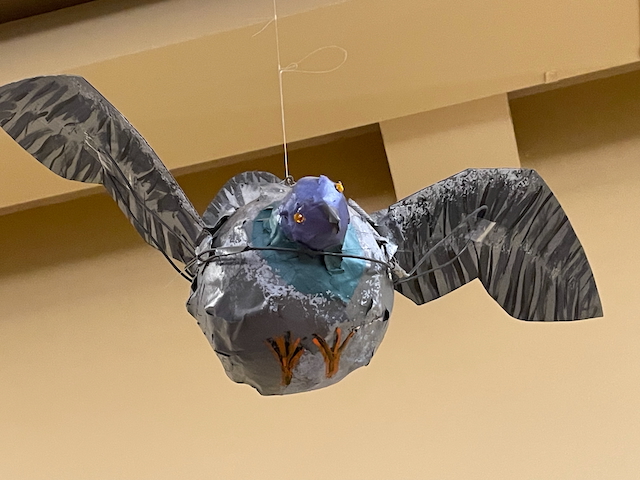
Isaac Hillman’s 1888 book,“Methodism in Troy,” is our main reference to the earliest days of the Methodist congregation on State Street in Troy, NY. We spent a whole year celebrating our 200th anniversary in 2007-8, including re-enacting some of those tales. We began with 3D wire and paper pigeons flapping their wings as they flew down wires from the balcony, over the heads of the congregation, landing at the communion rail at the start of worship one morning: an invention of resident engineer and installation creator, Alice Rose. They were decorated by members of the Sunday School and volunteers from the congregation, and 4 remain hanging in Fellowship Hall as a reminder of the dramatic event.

But why pigeons? In particular, why did we start with pigeons? It is because of a story told by Hillman. Here are his words:

”The congregation began to seek a suitable site for a meeting house. On the uninclosed ground then known as the Common, lying east of the line of Fourth Street, an eligible plot was found, which was designated on the map of the village as lots 743 and 744. They were originally part of the farm of Jacob D. Van der Heyden, which had been surveyed and laid out into building lots in 1807. As he had generously given to the Presbyterians and Baptists the ground on which they had built their meeting-houses, it was thought that if he were respectfully solicited he might be induced to convey lots to the society as a gift. When he was approached it was found• that he was not only unwilling to part with the property but personally opposed to the project of the society, asserting that the Methodists had no need of a meeting-house. Dr. John Loudon, a popular physician, who had begun his practice in the village in 1793, became greatly interested in the welfare of the society of which in 1810 he became a member, and he undertook to intercede with his brother-in-law to convey, for a small consideration, the lots to the trustees of the church. It is related that the business so much engaged his thoughts that one night he dreamed that he saw a large flock of pigeons fly over the village and settle down on the proposed site of the meeting-house. This dream he interpreted to presage the future prosperity of the church. After some further overtures, Jacob D. Vander Heyden consented to sell the ground for $500, demanding, however, the payment of an interest annually of $35 until the property was possessed by the purchasers. The conveyance was made on Christmas day, December 25, 1808.” (pp23-24 Methodism in Troy, Hillman, self-published 1888.)

The  first two buildings were on that same piece of land, on the eastern edge of the Williams Street alley between Fourth and Fifth, facing State Street, where the parish house and garden are today. Early illustrations show that the first small white clapperboard building was on otherwise empty ground. The land had been Jacob D. Vanderheyden’s farm. This was the land which Vanderheyden had made available for the African American community, enslaved and free, to hold their annual week-long PInkerfest celebration. As the influence of the original Dutch farming families – with their numerous enslaved workers – waned, the land reverted to common land which Hillman describes as “not very inviting” as it was mostly dense weeds, briars and very little grass. Hillman further writes that a nearby stream would frequently overflow and leave “a strip of water on the east side of the church where children, in winter, found good sliding on the ice covering it.” (Hillman, p 27)

Housing at the time was still limited to First, Second and Third Streets with most commercial buildings on the banks of the Hudson, on River Street and increasingly along Congress Street: the land was, at the time, truly on the edge of the village.

The years of the 19th century would prove Loudon’s dream interpretation to be valid. The State Street site was the scene of many religious revivals, and birthed Sunday Schools and new Methodist churches in the area, as well as inspiring many to become pastors.

The trustees of the congregation solicited funds to build the “Troy University”, a towering ideal which sadly graduated only one full 4 year class, as original benefactors decided to promote other academic institutions. The building, with its four tall spires, dominated the Troy skyline for more than a century. It stood on the hill at the end of State Street, in full view of the congregation as they came to worship. When the university closed for lack of funding, it  was purchased by the rapidly growing Roman Catholic faithful, and eventually sold to RPI. The last part of the original 1840’s structure was torn down 120 years later to build the current RPI library. 

On the edge of Round Lake, a  Methodist campground, set up by Hillman and his colleagues, in 1868, attracted 20,000 people annually to hear the preachers. It became a Chautauqua-style educational meeting, before becoming the settled village we see today, with houses built on the original church tent plots. Attendees gathered to hear well-known preachers and to sing hymns. The magnificent 1847 organ, which was placed in the tabernacle in 1888, is regarded as a treasure of the organ world, and the public can attend organ recitals every Summer.  Methodist Farm on Crooked Lake, which is still operational as a Methodist summer camp, was bought and set up by local Methodists in the 1920’s, including the financial support of the State Street Methodists. 

This all started with a dream about pigeons. As in the time of Jesus, early settlers of this nation  put great store in dreams as a way for God to inspire them. A dream could sway even a staunch opponent like Vanderheyden to have his mind changed – at a price! 

In the late 1860’s a plan was formed to build the current church, and the adjoining plot – now nowhere near an overwhelming stream – was purchased to make the site the size it is today.

As for Troy’s actual pigeon flock – some of whom survive despite the attentions of bald eagles and a variety of  hawks – they can be seen at the end of the next block from the church at Barker (“Pigeon”) Park, along the Riverfront and in Monument Square, where some kind soul throws out food for them each morning.

The life of Dr. Loudon,  the Round Lake campground, Methodist Farm on Crooked Lake, and Troy University will all have their own essays  – as will the subject of antagonism toward early Methodists, as witnessed in the difficulty with which the congregation secured the land it still holds to this day.

Janet Douglass, August 2025.

Reed Brockway Bontecou (1824 – 1907)

Stories from the lives of members of the State Street Methodist Episcopal Church

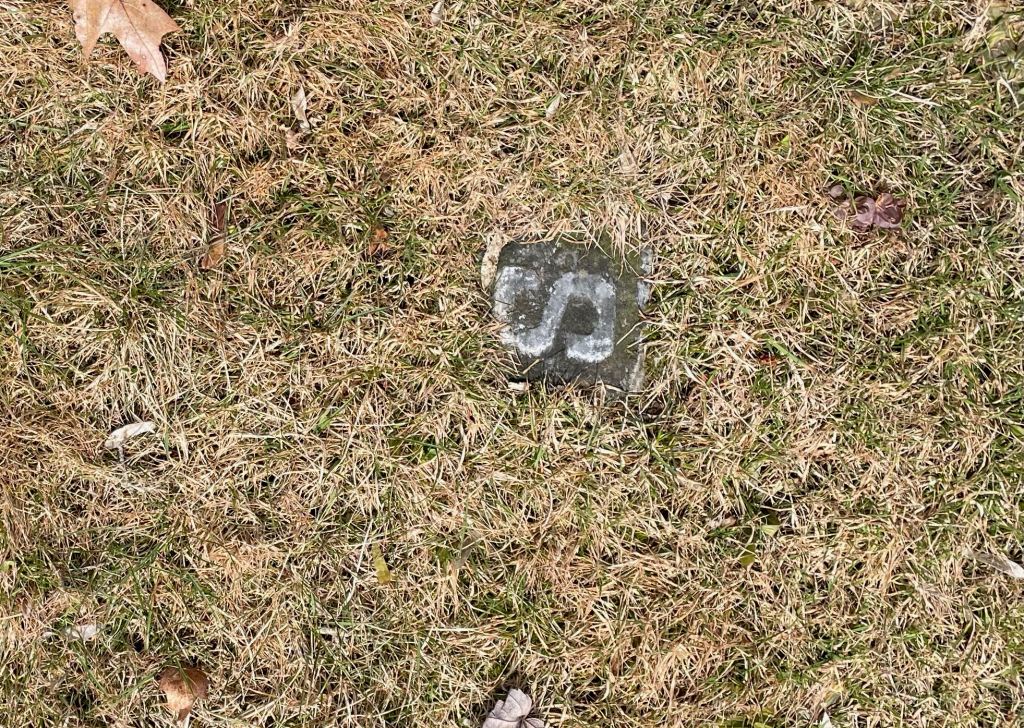
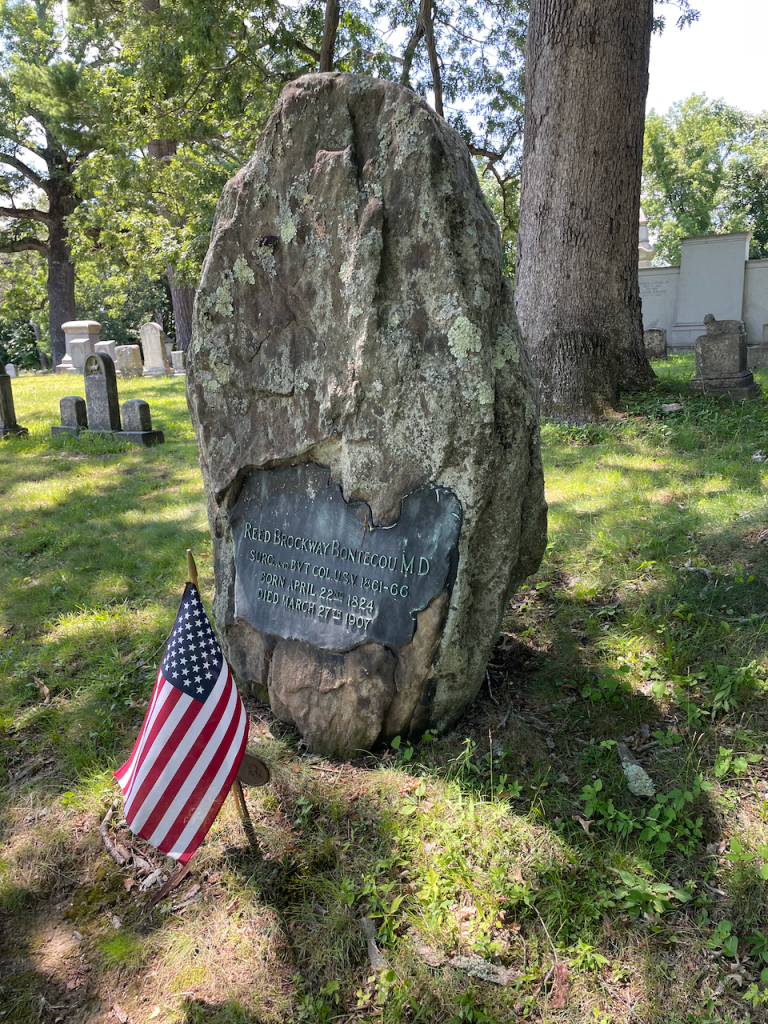
The gravestone of Reed Brockway Bontecou M.D. in Oakwood Cemetery, Troy, NY.

While the Cluett family, which played such an important part in the history of Christ Church, is now probably the best remembered name locally, on a national scale the most renowned person, by far, would be Dr. Reed Brockway Bontecou.

Dr. Bontecou’s name appears in medical journals dealing with surgery techniques and the beginnings of plastic surgery, in photographic journals detailing his photographs from the Civil War, and on Civil War and veteran sites, because of the pioneering nature of his surgical methods and how he recorded them in photos at such an early date of the craft. A few years ago, the Hart-Cluett Museum in Troy had a whole exhibit dedicated to Dr. Bontecou and displayed his medical bag.

In terms of the history of Christ Church, United Methodist in Troy, his lifetime spans all three of the buildings that have stood on State Street between the Williams Street alley and 5th Avenue, growing up in a devoted Methodist family. 

He was descended from Pierre Bontecou, a French Huguenot, who was linked to Dutch Protestants before him. Pierre arrived in New York City as a refugee from the regime of King Louis XIV in the late 1600’s, and the family originally worshipped in a French speaking Huguenot (protestant) church. One branch of the family ended up in New Haven, CT. They were industrious and successful, but like many in the area suffered financially and physically at the hands of the British during the struggle for independence. This brought one branch of the Bontecous to the “village of Lansingburgh”  in the late 1780s. Subsequently, Peter Bontecou, father of Dr. Reed Brockway Bontecou, was brought to Coeymans by his parents. But when still “a young lad” he removed to Troy to work as a clerk in a shoe store. He later became the proprietor.

Peter was a lifelong and ardent Methodist. Whether he heard about Methodism when he arrived in Troy, or had already made contact with the dedicated group already established in Albany County, we do not know. However, our records show he was a leader of State Street Methodist from its earliest days until his death in 1868. The family genealogist describes him as “cold and austere in manner, and strictly honest in all his dealings; a member of the Methodist Episcopal Church, and a great student of theological works.“

Reed was his first child. He had married Samantha Brockway in Troy in 1823. A year later he had a motherless infant son. Samantha’s death 2 weeks after giving birth was credited by some historians for Reed becoming a physician. 

Even as a child, Reed was studious, with a naturally curious, scientific mind. When a boy, he started a collection of sea shells and he noted the similarities and differences as he catalogued them. According to the History of Rensselaer Co., New York by Nathaniel Bartlett Sylvester, published in 1880, he attended the “High School Academy” then Rensselaer Polytechnic Institute and then graduated M. D. from the Castleton Medical College, VT. At the age of 22 years, between attending RPI and medical school, he went on a year-long voyage up the Amazon to study. He was married, on July 18, 1849, to Susan Northrup and they went on to have 5 children. 


In 1857, at the Troy Hospital, Bontecou “ligated the right subclavian artery for diffuse traumatic aneurysm of the axillary artery, the first successful case in America and one of the first three on record” https://en.wikipedia.org/wiki/Reed_Brockway_Bontecou

 In 1861, he left his physician’s practice to become the medical officer of the Second Volunteer Infantry of New York. Within 3 months he was running the Fortress Monroe military hospital and then was asked to lead Harewood Hospital in DC, which he left at its closure in 1866. By that time he had been brevetted lieutenant-colonel and colonel of volunteers for his faithful and meritorious services during the war. 

He returned to Troy and became the assistant surgeon at the Watervliet Arsenal, resident surgeon at Marshall’s Infirmary off Hill Street in South Troy, and had a private medical practice for four more decades. He is quoted in numerous coroner’s reports in Troy and area newspapers, was an official examiner for those seeking Civil War pensions, and held a number of prestigious positions in medical societies. He published reviews of his work and inventions, which included a special kit for soldiers to take with them into battles to self-treat a wound until help arrived, greatly increasing their chance of survival.

His name appears in the works of Arthur Weise who published several books on Troy in addition to Sylvester’s history of Rensselaer County. The Hart Cluett Museum had a display about his life and work, a few years ago, and displayed his medical bag.

According to the site dedicated to medical collections: “Bontecou’s peers respected ‘his unselfish character, his strict devotion to the truth, his extreme modesty and his unswerving fidelity to his students, colleagues and friends,’ noted one physician. Another doctor called him, ‘the Napoleon of Surgeons.’ “ That site hosts a long article, with illustrations, and catalogs his medical achievements. It is entitled: “Dr. Reed Bontecou’s Pocket Surgical Wallet, Bloodstained from the First Recorded Battlefield Amputation in the Civil War, on a Soldier of the 5th New York (Duryee Zouaves) And the Coins Driven into a Soldier’s Groin by a Bullet!”

The “Faces of the Civil War” blog has an entry entitled “The Napoleon of Surgeons” about Bontecou. http://facesofthecivilwar.blogspot.com/2013/05/the-napoleon-of-surgeons.html

In addition to the medical sites, he is remembered on historical photography sites for his pioneering use of the art as a documentary tool during the Civil War. This site has the most extensive descriptions of those achievements:

One of the largest online collections of his photographs can be found at: 

https://www.robertandersongallery.com/gallery/reed-bontecou/

The site says: “Reed Bontecou was responsible for pioneering, and taking, the largest number of photographs of wounded soldiers during the Civil War and was the single largest contributor of photographs and specimens to the Army Medical Museum and medical publications of the time. His close up images of surgery, anesthesia, and patients posing with their pathological specimens were unique to his time.”

Just a few of the many sites which speak of Dr. Bontecou, for all his great qualities, do recount a lapse of judgment and somewhat of a fall from grace, in a situation that caused his wife Susan Northrup Bontecou to file for divorce.  Details are few. One site (the Faces of the Civil War blog,) quotes a New York Times report that Susan’s accusation was “criminal intimacy”- the term used for an affair with a married person – and gives two names for the woman involved. All other references state simply that they divorced because of his affair with a young woman. For now we will leave it at this: in the strict society of his day, and doubtless among his colleagues and social group, this brief affair must have been quite a scandal, and stirred up much gossip once divorce proceedings began, but I have found few references to it.* What we do know is that, despite the embarrassment and notoriety, Dr. Bontecou did not leave the city in disgrace and his career does not seem to have been radically changed by the events. He continued to be a member – and head of – various esteemed organizations and to work with the military, at Marshall Infirmary and in private practice in Troy. The divorce was finalized in 1883. He never remarried.

Bontecou died in 1907. He is buried in Oakwood Cemetery, Troy.

(The photograph was taken by the author on 4th July, 2025. The headstone is very unusual, and I have not seen another in the century which is uncarved rock.)

Other interesting articles:

https://spotsylvaniacw.blogspot.com/2013/07/podcast-battlefield-photography-of-dr.html

https://www.hartcluett.org/rensselaer-county-blog/dreadful-accident?rq=bontecou

https://www.seekingmyroots.com/members/files/G000711.pdf

Bontecou genealogy, which starts with the amazing maritime adventures of a famous Dutch family member. 

The FindaGrave website includes additional details of his Civil War Service I have not seen elsewhere and photos of the doctor, in uniform and on horseback. 

https://www.findagrave.com/memorial/7050830/reed-brockway-bontecou

*Ron Coddington’s blog: Faces of the Civil War  says: “Susan Northrup (1828-1911) and Bontecou married in 1849. She alleged criminal intimacy between her husband and Emma Josephine Murray, also known as Emma Brockway. According to the 1870 U.S. Census, she is the daughter of Reed Brockway. There may be a genealogical connection between this branch of the Brockway family and that of Bontecou’s mother, Samantha Brockway Bontecou (1803-1824). New York Times, November 28, 1883.”  As I started to research the matter, errors in family trees made the strands of the tale hard to untangle for this essay: I may go back to researching who this Emma was, as the only Emma in the family was never known as “Emma Josephine Murray” – even a little research has thrown up other inconsistencies with even that brief account and no interest in the story in local newspapers so far – Janet

A Congregation where Innovation Runs Deep

Logo for Soul Cafe 1999-2005

In 1999, the pastoral team of Christ Church, United Methodist, Troy, NY, was led by the Rev. James Fenimore, whose first degree had been in Computer Science. Jim arrived at the church, not quite 30 years old, and aware of the possibilities of the new digital world for a downtown city congregation in a city with one of the leading technological institutes of higher education in the country. 

Christ Church became the first local congregation with a church website; the first Troy congregation to record services to CD and copy them for home distribution, then the first to offer DVDs and more…but I am getting ahead of my story.

In 1999, the website was up and running, CDs were, indeed, being produced, but Jim had had an idea based on his reading and conversations with other pastors he met at Drew Theology School, his alma mater…maybe what the church, what the city needed, was a different kind of church event: an evening “service” that did not seem like a church service at all. This would be nothing like a regular service: a dimmed coffeehouse setting, with good coffee and tea & snacks, free of course, live local musicians who could stop by on their way to the local busy bar music scene – paid a decent fee – and a big screen so we could show videos. The local “conference” of Methodist churches had just made it possible to buy into a licensing scheme to screen clips of current movies. Jim set about explaining the idea and winning the budget approval for the expense, which we thought would be near-impossible, but was, in fact, quickly approved, faster than we had dared hope.

We began to plan – and I have to say, there was real excitement about the idea. The upstairs fellowship hall would get round cafe style tables and candles, and a large back-projection screen would be placed on the stage, the projector hanging behind it out of view. Microphones for the musicians would be placed on the main floor of the room at the front, along with a couple of stools for the pastors, and the event run via a computer and sound system at the back of the room. The round tables were placed between those two areas. 

The “service” would have no hymns, no prayers, no spoken appeal for donations. It would begin with a brief introduction to a theme – a guiding metaphor – for the evening, followed by the musicians, at times a Christian rock band or singer, but mostly any local talent who wanted to perform, whether a college a capella group, a blues guitarist or band, a classical musician or even an opera singer. The music would last 20-25 minutes of a 40 – 45 minute gathering. “Soul Cafe” was meant to gather those for whom sitting face forward and being told what to say, sing, think and do, just did not work. The title came – with permission! – from one of Jim’s professors: Leonard Sweet had a magazine for preachers of that name, and it was so perfect for us, we asked to use it.

And the main event of Soul Cafe was always the movie clip. 

We would find a film sequence, often from a movie that was recently released, often days before so people had not had time to see it; where a more usual service would take a Bible passage and relate it to the world, Soul Cafe clips were picked to ask a question of the church. They represented a comment from the society about the society. So what did that society, have to tell us? The reflections would be no more than 5-6 minutes as the “service” ended, and the gathered group were always left with a question posed by the movie.

Well, I think the congregation, not just the leadership, felt we were being pretty “out there” to do this…

As the planning for “Soul Cafe”began,  the church was also starting to use Ebay as a way to sell donated items which had value, though not maybe to those visiting our fundraising events. The leadership team, also being interested in the history of the congregation, would also check Ebay in case State Street Methodist Episcopal items were for sale. Never the best at keeping records, we had found very few historical things in closets, though they included a blueprint from the early 1920’s lining a drawer. Interestingly, it showed that someone at that time was an innovative thinker: one of the plans even showed a ten pin bowling alley being constructed right under the aisles of the sanctuary!

It was a quick glance at Ebay while I was away in the UK that turned up some 80 year-old  bulletins of the church. I emailed the Senior Pastor, he put in a bid, and by the time I returned to Troy, the bulletins were waiting for me.

Imagine our surprise – and delight – to see maybe we were not as innovative as we thought! 

80 years before, in the days of silent movies, the Church had had movies at the evening service, an innovation of the Rev. Mark Kelley DD – probably the man who had the idea of the bowling alley under the church. 

We have only a few bulletins from 1921 and 1922, and many movie titles suggest they came from a religious source: a movie meant to inform about missionary work, or a Sunday School illustration (weren’t they on top of the latest developments!), but some of them seemed to be more about places in the world. I have traced a couple to an archive of educational films: Sights of Suva, Fiji* shown on Feb 19 1922; and Apple Blossom Time in Normandy** shown on May 8 1921.

As yet, I have not found any viewable copies, but wouldn’t it be fun to reenact one of those evening services, complete with their silent movie reel?

In 2005, the very week that the then largest, 50 inch, LED monitors came to market, the church installed two at the front of the sanctuary, along with 2 smaller ones further back, remotely operated digital cameras, a first-rate computer control booth and the latest recording and sound equipment. And so it was that the ability to screen movie clips came to morning worship and Soul Cafe ceased. The expense was considerable, and would have been unimaginable without what had happened in Soul Cafe, but it represented an openness of the congregation to embrace the new. With the new equipment, the congregation could now record CDs of worship, or weddings, or concerts, showing different angles and views. The Senior Pastor, Jim, was working on his Ph.D. on the impact of the digital revolution on church services around the country; the congregation was involved in planning, participating and running our media-rich and metaphor-based worship services. Another new era had begun – but  we now knew we were in a congregation which had valued the spirit of innovation and experimentation for a lot longer than we could have expected, when we started on our digital journey.

Janet Douglass, Troy, NY, March 2025.

Motion Pictures for Instruction 1926 by A.P.Hollis M.S. pub. The Century Co. New York 1926. Available as a Google book at: https://docs.google.com/document/d/1V3gCdNeICZOQdWuz5fckOWVWTcbxrEkaPDjaxNDqMLg/edit?tab=t.0

*reel 2 of 5 :  Fiji Islands by Burton Holmes Lectures,  Chicago; a rental film listed in Hollis p.348

** listed by Hollis, in the Blue-Ribbon List of Films for Cities p.213

The Rev. Dr. James Fenimore’s Ph.D. was awarded by RPI in Troy, and his dissertation “High-Tech worship: Media Technologies and Christian Liturgical Practice” is available on his website: www.JamesFenimore.com. His DMin. thesis: “How a Congregation’s Identity is Affected by the Introduction of Technology-Based Worship”  is also available on his website. He has 2 other theses available: “A church on the Edge of an Apocalypse,” a take on the history of Christ Church, is available online at: https://christchurchtroy.org/wp-content/uploads/2021/06/earlyhistory.pdf. Jim first featured the congregation – before he was appointed as the Pastor – in his thesis From meeting house to house of God : the Gothic revival in the American Methodist tradition of Troy Annual Conference (1870-1879), which is available from Drew University.

Jim’s academic work on digital worship included the benefits and pitfalls of using other people’s images as visual representations. The significance can be easily grasped if you have ever seen a so-called Bible-based commercial film, where white skinned, blonde-haired, blue-eyed males prevail scene after scene  (except maybe for Judas Iscariot…did you notice that?!) Movies can be enormously helpful – but graphical imagery can subtly mislead – or open us to the moviemakers’ biases or poor scholarship! Finding clips we wanted to present was always no quick task but could lead to valuable conversations about whose ideas prevail in society, and how to be a critical viewer of the imagery around us. 

Mr. Cook’s Farm

13 of the farmsteads in Pittstown, NY, have been approved for the National Register of Historic Places, including a farm which served as an early meeting place for the first Troy Methodists.

“Henry Cook was one of the wealthy farmers whose kind hearts were ready to sustain the meetings, and whose large barns in the early days of Methodism served on Sabbaths as churches. “In 1800 or 1801,” Miss Curtis says, “when I was a young girl, I remember hearing Benjamin Stephens preach in Mr. Cook’s barn.” (…) The inconveniences of holding meetings at the dwellings of the members and in the court-house were evidently detrimental to the strong growth of the society. “In the court-room,” as Phebe Curtis relates, ” some- times on summer evenings, it would be nearly nine o’clock before the congregation could be seated. This was not owing to the slackness of the brethren in making timely application for its use, but because the person who had the key, or the one who rang the bell, had no interest in our prosperity.” From “Methodism in Troy” by Joseph Hillman, self-published 1888.  pp 22-3.

That two-sentence record of early Troy Methodists gathering in a barn, has led to some tantalizing clues about the importance of the Cook-Hayner-Halford Farmstead at Cooksboro Corners in Pittstown, for the growth of Methodism in the region.

Phebe Curtis, the young daughter of Caleb Curtis, and so from one of the earliest Methodist families in Troy, wrote a history of the congregation in the early 1800’s. The work is lost, but was frequently quoted by a number of local historians later in the century, including Hillman’s Methodism in Troy, which was the impetus for the research being undertaken by Alice Rose and I. Phebe wrote of the earliest Methodists and where they met, locations identified only by the owner’s name – which was adequate in a still tightly-knit village of a hundred or two residences, but frustrating to our research today, as we try to find out which of those early Trojans offered them a place to gather.

Journals of the time and histories from the following century described some of the difficulties of  starting a Methodist society in the early days of both Methodism and the history of the United States, something we can read in the diaries of the early preachers, many of whom endured beatings. Historians of Troy also recount some of the resistance to the society buying land for a church building – resistance which other denominations did not encounter.

As part of my research into early meeting sites for the congregation, I began looking for a farmer called Henry Cook…searching West Troy, Albia, then moving out to Brunswick, Poestenkill and the Greenbushes: nothing. The search illustrates the difficulty we are having locating places and the people who became the first State Street Methodist society. Women, of course, often go by the names of their spouse; servants, particularly if African American, slave or free, by their first name; houses identified by the owner with no location. Finding any Henry Cook with a farm took months of peering at maps, reading census documents and the journals of early preachers. 

Until the day – and I cannot think what prompted me to think it, but probably some Vanderheyden genealogical digging – I thought: ‘what if his name was not Cook – what if Cook is an anglicization of a Dutch name?’ In hours, I was on the trail: some of the Vandercook family seemed to have contracted their anglicized Dutch name, to Cook! Searching for the Vandercooks in censuses brought me to Pittstown, and also revealed that while the Vandercooks did not list many people of color on census forms, only one of the farmholders listed none at all…and that this farmer, Henry Vandercook, was often simply listed as Henry Cook. (Though also with the first name in its Dutch version: Hendrik, and the last name spelled differently: Henry/ Hendrik Van Der Cook or Henry Vander Cook or H.V. D.Cook or even with the last name Vanderkeock…but despite the variations, they all pointed to the same man.) 

Had I found “our “ Henry Cook?

It was not a given that I would locate a Cook with a farm, where there were no slaves. The farm owner could have made an arrangement with the Methodist group, who paid to use his barn –  but I had found a Cook with a farm, and therefore a barn, in a county which had considerable slave labor at the time, and this Cook had none. There was a chance I had found a follower of Wesley. 

Further research showed that  by 1795, Henry Cook was the leader (steward) of a Methodist class. Finding him in a leadership role that early confirmed he had known about Wesleyan teachings for a few years at least, predating the visit of Lorenzo Dow, a very famous preacher who came to Pittstown. And why Pittstown? Probably because at about the same distance as Troy was from Pittstown, but in the opposite direction, lay the farm formerly of Philip Embury, founder and builder of both the first and second Methodist structures in America , John St Chapel in New York City… and Ashgrove Chapel in Cambridge, NY. 

I doubt that Henry Cook was a Methodist during the lifetime of Embury who died far too young, in 1775, or that he visited the farm of Embury’s fellow Irish Methodist cousin, Barbara Heck, the so-called Mother of Methodism. She had helped found and run the John Street society in New York as well as the one in Cambridge. Those founding Methodists moved to the north shore of the St Lawrence at the end of the Revolutionary War: this group of Palatine German Protestants found themselves unable to support the Revolution out of loyalty to the British crown, which had rescued them from persecution on the European continent. But many – like Cook himself- who fought for the liberty of America did nonetheless join the Methodist cause, despite its  British origins, and they would have worshiped alongside other patriots as well as those who fought against them. For them the theology really mattered more. 

It is hard to imagine today, just how much furor and opposition there was to Wesleyan teachings. Methodism today is just one of many Protestant groups, which seem much the same. But in the 18th and 19th century, it stood alone in opposition to the Calvinist ideas of Presbyterian, Baptist and Reformed theology. Where they talked of the “elect few” who could be right with God, Wesley’s followers declared all could be saved. And not only all could be saved, but they could feel it, know it. The 18th century Irish Methodists who did not flee to Canada, and the group they had attracted,  stayed in Cambridge and continued to talk about the teachings of John Wesley. Meanwhile, 11 miles to the West of Pittstown, in Schaghticoke, Captain Groesbeck was inviting Methodist preachers to speak in his barn. The great Frederick Garrettson writes that he had a great reception there on September 24th, 1791, 4 years before we find Henry listed as the class leader. These farmers were spreading more than the seeds of wheat in their fields…they were seeding the church!

Janet Douglass, February 2025

At a distance of 16 miles from Troy, ‘Mr. Cook’s barn’ became a gathering for Methodists in the late eighteenth century. It is a piece of land which would eventually be the home of the Cooksboro Methodist Society, sharing this piece of Vandercook land with a cemetery and a schoolhouse. A barn with some distinctive early Dutch features remains visible on the land which is still a working farm. The address is #346 Cooksboro Road (CR 126), in Pittstown, NY,and the barn is near the junction with Plank Road. The church is no longer there, but its location is discernible. Henry is buried a little way down the road in the Old Cooksborough Cemetery, not the adjoining graveyard,  but both are generally off limits for safety/accessibility reasons. You can see an image of his tombstone at this link: https://www.findagrave.com/memorial/10289425/henry-vandercook

John Wesley grew his theology to stand in opposition to the prevailing Calvinist thought of his day. Many of his letters and treatises deal with this issue. Almost as many show his interactions with the British Government on the need to prohibit the use of British ships in transporting Africans westwards, and stop Britons profiting from slavery. These sentiments, along with its British origins, meant early Methodism had cause to be unpopular with many. That it grew as large and as fast as it did, attests to the work of the early leaders, their character and their determination.

A different version of this essay, with another emphasis, appears in the February newsletter of the Pittstown Historical Society. whose wonderful archive about the Vandercooks confirmed I had found “our Henry” and helped me understand more about the farm and the neighborhood in his day.

The Methodist Episcopal Churches of Troy: State Street/ Fifth Avenue-State Street/Christ Church United Methodist

Part of the series of extended essays on the early Methodist societies of Troy, New York.

The current sanctuary is the third building to house the Methodist congregation on State Street in Troy, NY, but it was a private home on State Street, which was regarded as the site of Troy’s first Methodist gatherings in the earliest days of the community, which would become the City of Troy. Records suggest Methodists first met on State Street in 1793. It is not yet possible to determine whose home that was and the location, but at that time there were few domestic buildings, and they centered on River, First and Second Streets. So, presumably where one of those crossed State there was a home where early Methodists found themselves welcome – which could never be assumed. Early Methodists were met with much opposition.

After its rocky start – Methodism did not have as many adherents as other protestant denominations at this point, and avowed Methodists were subjected, to ridicule, name-calling and outright violence for their beliefs – the congregation became sufficiently large and established, to need its own building. Lingering prejudice about the denomination is witnessed in the difficulty in obtaining the land to build. Jacob D. Vanderheyden, the landowner, had donated land for other denominations, or made the land extremely inexpensive for them to purchase, but he refused to sell land to the Methodists for a long time. It was the intervention of his brother-in-law, Dr. John Loudon, who shared his dream of pigeons “flocking” to the desired site, that is credited for Vanderheyden’s change of heart. Nonetheless, the Methodists paid top dollar for their piece of land.

The congregation was incorporated as “The Methodist Episcopal Church of the Village of Troy” on November 29th, 1808, and a few weeks later, on Christmas Day, Vanderheyden conveyed the land to the trustees, having agreed to sell the land for $500, though with a $35 annual interest fee until paid off in full. The piece of land they acquired was the western half of the current site: two narrow lots, which has been designated the previous year as city lots 743 and 744, on the north east corner of State Street and Williams Street (the alley.) The building stood in what is now the small garden area in front of the parish house. It was two stories tall, plain, weatherboarded and painted white. The subscription started to pay for the construction of this modest building, despite having masons and carpenters in the congregation who gave their skills at no cost, still meant that the church was not ready to use for worship until 1811. Hillman reports that one of the largest sums donated came from Phebe, the daughter of Caleb Curtis: $5. He hints that there were very many, but very small donations, from those with less to give. The list of donations in the subscription book closed at $557.82.

The earliest drawing of that first clapperboard building is in A.J. Weise’s ‘Troy’s One Hundred Years” in which the building stands open on all sides. Weise describes the location as being built next to the common land. This was the land, donated by the Vanderheydens, for the annual Pingster or Pinkster Fest. Each Pentecost, both enslaved and free African Americans would gather for their annual celebration on this land, which included plenty of eating, drinking, music, singing and dancing…(See my essay on the African Zion congregation.)

The building was opened, still unfinished, with rough benches having been hurriedly made from planks by the congregation’s carpenters, just in time for the first service. Hillman reports the land around was not inviting and consisted of thick weeds and briars and patches of bare earth. The remains of a small stream passed by the eastern side of the building and when it iced over in winter, the narrow strip made for “good sliding” for the children.

Over time, the hurriedly made rough benches were replaced with slightly better plain pine benches, backed with a narrow board, but still at that time the pulpit was a a plainly-constructed desk on a small platform with several chairs. Tallow candles in tin sconces along the walls of the church lit it when evening meetings took place. By 1817, the church had a fence, which Hillman reported was to be “painted either all red or Spanish brown except the front part which was to be white”, as in the etching above from Hillman’s book. At the same time seats were added to the gallery and were likely the ones removed from the main auditorium. Women and girls sat on the east side, and men and boys took seats on the west side. The pulpit too had been replaced, Hillman reporting that there not being enough space, the children sat on the kneeling-step which surrounded the “altar.” (Hillman,p 46)

Frederick Garrettson – a man of great renown in the history of American Methodism – whose daughter traveled with him and acted as a secretary for his travels passed this on to his biographer:

” From Schenectady they returned to Troy, and put up at the house of the Hon. George Tibbits, whose hospitable mansion is delightfully situated on the side of a sloping hill ascending from the eastern part of the city, denominated Mount Ida. On the Sabbath, Mr. Garrettson preached in the Methodist Church, in this city, morning, afternoon, and evening, to an attentive congregation; and ‘truly’ says he, ‘it was a good day.’

He remarks that when he visited this place about thirty years before (in 1788) , there were only a few scattering of houses, and no Methodist society; but that he now rejoices to find a flourishing little city, in which there were four houses of worship, and not less than three hundred members of the Methodist Episcopal Church. what seemed to add to his religious enjoyment was the catholic and friendly spirit manifested by the several religious denominations toward each other. (Hillman, p 45-6.)


Even so, it was not until 1823 that the congregation secured sufficient money to pay off the debt on that first building. Only 16 years after its opening for worship, the congregation had outgrown their space: a new, larger sanctuary was required. On February 28th, 1827, the building was sold to Thomas Read and Sterling Armstrong for $500, only taking possession on November 1st. The first building had been moved to the corner plot, immediately east of its original location, the common land no longer being used for its intended purpose. So it looks like they shuffled the clapperboard building along, and worshiped there, while the brick chapel was being built. There, it was afterward used as a temporary court house, while the first court house on 2nd Street was being constructed, and then as a grocery store, until the erection of the current stone church in 1867. (Hillman p. 48 and p.52).

In the 1860 stereograph below, taken from the corner of State and 4th Streets, looking toward Troy University – about which, much more later – the brick sanctuary can be seen and beside it, a little harder to discern, is a much smaller, white wooden clapperboard building… standing there until the site construction of the current limestone sanctuary, which began 7 years after the photo was taken.

Dr. Loudon, his dream of pigeons, his work as one of Troy’s earliest doctors, and his importance to the congregation will all be covered in a later post.

The main historical source for the congregation is Joseph Hillman’s 1888 book “Methodism in Troy.” Other histories of Troy and Rensselaer County, many of which, like Hillman’s book, were published around the 100th year anniversary of the naming of Troy, include similar information. These include several books by A.J.Weise and also Rutherford Haynes and Sylvester Peck. All are available to read at no cost online. The Library of Congress site is a good place to start, but Google books and various university libraries also have digital versions. The stereograph above is from the Library of Congress archive, and is available for free use as part of the Charles F. Himes collection (Library of Congress Control Number 2005687324.)